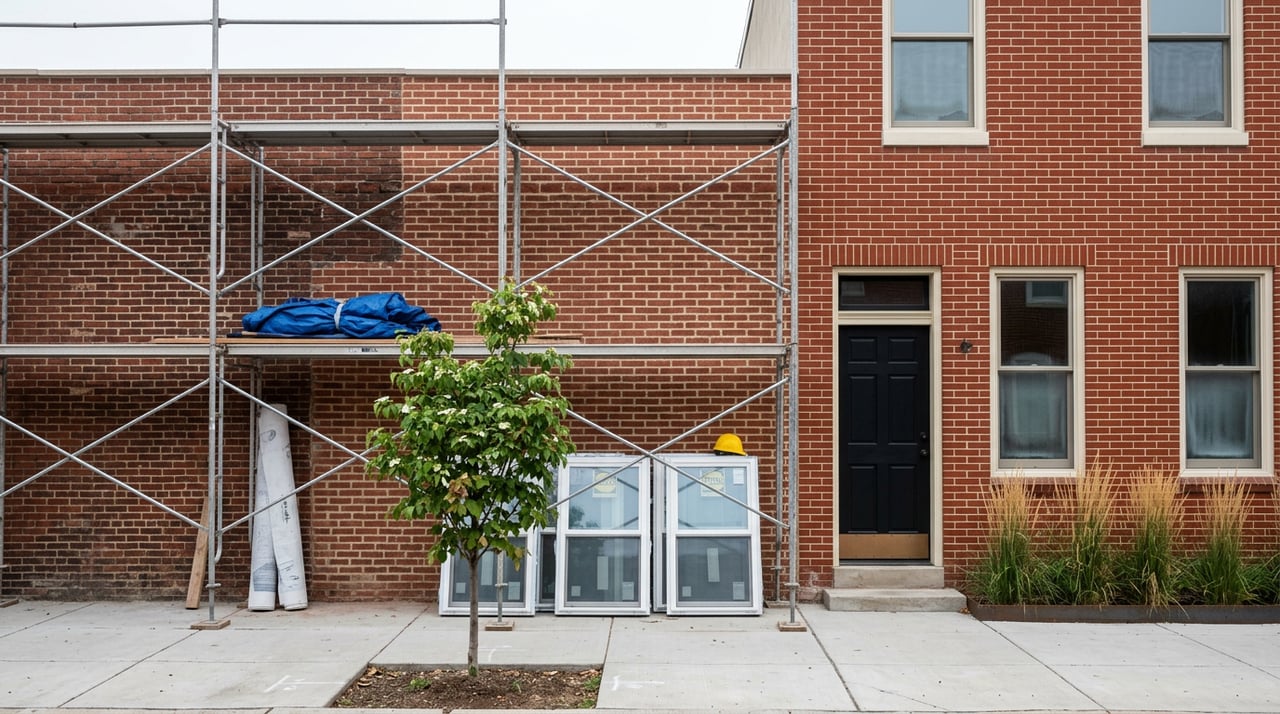
According to WHYY, two rowhomes on the same Sharswood block can have different property tax-abatement schedules over the next decade, even at the same purchase price, because both the permit date and whether the work is new construction or rehabilitation matter. Those details should give any buyer or investor pause before treating a listing price as the whole story in this North Philadelphia neighborhood right now.
It matters because Sharswood is behaving strangely. Zillow's typical home value for Philadelphia as a whole was down 2.2 percent over the year ending in June 2026. Meanwhile, Redfin's neighborhood-level tracker showed Sharswood's median sale price up 3.5 percent over the three months ending in April 2026, and Homes.com put the twelve-month gain at 8 percent through the same month. One neighborhood-level tracker shows price gains while Zillow's citywide home-value index is down, even as Redfin reports a citywide gain. That difference is worth explaining rather than treating the figures as directly comparable.
The Number That Doesn't Match the Headline
Start with why the citywide numbers disagree with each other before even getting to Sharswood. Redfin's citywide median sale price was $300,000 over the three months ending in June 2026, up 5.2 percent year over year, with the average house price hitting $290,000 the following month. Zillow's home value index told a different story over roughly the same window: $221,032, down 2.2 percent. These are not competing opinions about the same thing. Redfin's figure tracks what homes actually closed for. Zillow's is a smoothed estimate across the entire housing stock, including homes that never listed. When the two disagree this much, it usually means the market is splitting: a shrinking pool of homes selling at higher prices, while the broader stock of ownership stays flat or slips.
That split matters more, not less, once you zoom into a neighborhood the size of Sharswood. Redfin counted only 4 homes sold there in April 2026, up from 3 the year before. A median built on four transactions moves violently with a single high or low sale. So when Sharswood's median swings from $235,000 on Redfin's three-month window to $254,900 on Homes.com's twelve-month calculation, part of that gap is real appreciation and part of it is simply what happens to any statistic drawn from a handful of sales. Anyone underwriting a purchase off a single portal's number for a neighborhood this size is underwriting off noise as much as signal.
What's Actually Moving the Number
The signal underneath the noise is real, and it has a name: the Philadelphia Housing Authority has put $750 million into Sharswood, described by WHYY as the largest revitalization effort of its kind ever undertaken by a U.S. housing authority. That investment did not arrive as a single check. It arrived as a sequence of specific, named projects that changed daily life in the neighborhood before they changed comparable sales data.
PHA relocated its own headquarters to the Ridge Avenue commercial corridor in 2019, putting a major public employer inside the neighborhood rather than adjacent to it. A Grocery Outlet opened at 21st and Ridge, the first full-service supermarket in Sharswood in more than 50 years, with an ALDI following further west. Vaux High School reopened as part of the same push to rebuild civic infrastructure alongside housing. And in April 2026, PHA and its development partner The Michaels Organization celebrated the grand opening of the Harlan Sharswood Townhouses, a $32 to $33 million project that added 43 new townhomes and completed a full rehabilitation of the existing 71-unit Sharswood Townhouses community, bringing the total to 114 units serving households earning between 20 and 60 percent of area median income.
"It's in transition," says Herman Arce, president of the Brewerytown Sharswood Community Civic Association, in Homes.com's Sharswood neighborhood guide, describing a neighborhood where new development is drawing people back for its convenience.
This is the mechanism. A supermarket, a relocated headquarters, and a reopened high school function as leading indicators. They tell a buyer something about where a neighborhood is headed well before enough private-market sales accumulate to move a median price with statistical confidence. Anchor investment tends to arrive first. Comparable sales data catches up later, and unevenly.
Rising Price, Slow Sale: The Part the Median Doesn't Show
Here is the part that should temper any enthusiasm about Sharswood's price trend: a rising median is not the same thing as a liquid market. Citywide, homes sold in an average of 47 days over the three months ending in June 2026, up slightly from 43 days the year before. Sharswood's own Redfin figure for April 2026 was 55 days, already slower than the city. Homes.com's broader twelve-month calculation put the Sharswood average closer to 105 to 108 days, nearly double the citywide pace and well above the national average the same source cited.
That gap tells a specific story to anyone thinking about entry and exit timing. Prices are moving up because the properties that do sell are finding buyers willing to pay more for a neighborhood with visible new investment. But the buyer pool remains thin enough that a typical listing sits for well over three months before it closes. For an owner-occupant, that mostly means patience and negotiating room. For an investor modeling a hold-and-exit strategy, it means the appreciation shown in the median may take considerably longer to realize on any single property than the headline number implies. A rising price with a long time-on-market is a market repricing itself before it becomes efficient, not a market that has already arrived.
Understanding the Tax Abatement Clock
This is where the two-rowhomes-same-block problem comes back in, and it deserves more attention than most buyers give it. Philadelphia's 10-year property tax abatement, in place since 2000, was reformed for any building permit issued on or after January 1, 2022. Before that date, new construction received a flat 100 percent exemption on the value of improvements for the full decade. Under the current version, new construction gets a declining exemption instead: 100 percent in year one, then stepping down by 10 percentage points every year over its 10-year term. Renovation and rehabilitation projects, notably, were left on the old flat 10-year schedule regardless of when the permit was pulled.
In a neighborhood like Sharswood, where the housing stock is a genuine mix of century-old rowhomes getting rehabbed and brand-new construction filling vacant PHA-controlled parcels, that distinction is not academic. A rehabbed rowhome with a 2023 permit and a newly built one on the same block with a 2023 permit can carry meaningfully different tax trajectories over the next several years, purely because one qualifies as rehabilitation and the other as new construction. And when an abatement does expire on either type, the effect on a monthly payment is not trivial. One 2026 industry analysis found that a mortgage escrow recalculation after an abatement expires can raise a monthly payment by $300 to $600 or more, even with no change to the interest rate.
There is one more wrinkle worth flagging rather than assuming. In January 2026, Pennsylvania authorized Philadelphia to create a new, narrower tax abatement, up to 20 years, aimed specifically at converting large underused industrial, commercial, or government-owned properties in areas the city defines as deteriorating. That tool is built for adaptive reuse projects, not for a typical single-family rowhome purchase, but Sharswood's documented history of civic disinvestment and its stock of PHA-controlled parcels make it exactly the kind of area where a project like that could eventually surface. Anyone evaluating a larger acquisition or a multi-unit conversion in the neighborhood should ask, before finalizing an offer, whether the parcel could touch this program once City Council finishes the ordinance.
What This Means If You're Comparing Neighborhoods
None of this settles whether Sharswood is the right move for a given buyer or portfolio. It does settle what question to ask. The median price tells you where the neighborhood has been. The days-on-market figure tells you how much patience a purchase or a sale will require. And the permit date and whether the work was new construction or rehabilitation help determine which abatement schedule applies, a detail no listing price captures on its own.
That is the kind of layered analysis that belongs in a real estate decision tied to a broader financial plan, not just a search for the next listing. Public investment moving ahead of private pricing happens in specific pockets of a city at specific moments, and reading it correctly means looking past the headline number to the mechanism underneath it.
If you're weighing a purchase, a rental acquisition, or a portfolio move in North Philadelphia, or comparing it against other Greater Philadelphia neighborhoods, the team at Next Chapter Real Estate Planners starts with the strategy conversation before the property search. Book a Strategy Session to walk through what a specific block, permit history, and timeline actually mean for your goals.
A Few Direct Questions
Is Sharswood the same as Brewerytown? No. They are adjacent, and listings sometimes blend them because Brewerytown's growth has spilled into Sharswood, but they are distinct areas with separate transaction histories.
Does a rehabbed rowhome always keep the old flat abatement? Renovation and rehabilitation projects have remained on the original 10-year flat schedule even after the 2022 reform, according to reporting on the city's abatement program. New construction is what shifted to the declining schedule. Always verify a specific property's permit type and date with the Office of Property Assessment rather than assuming.
Why does one source show Sharswood's days on market at 55 and another at over 100? Different platforms pull from different date ranges and listing sets. With only a handful of sales recorded in a given month, small differences in methodology produce large differences in the headline number. Treat any single-source neighborhood statistic as a starting point for questions, not a final answer.
This article is general information, not legal, tax or financial advice. Consult a qualified professional about your situation.